
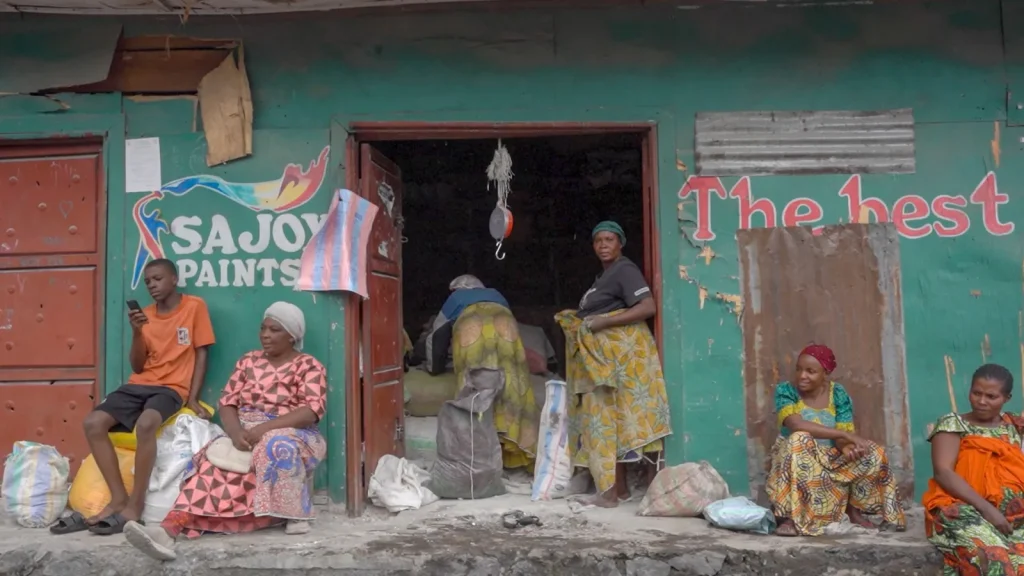
Balingene Kibetsi, a woman in her 60s with a child strapped to her back, stood beside the ruins of her wooden house in the small town of Sake, in eastern Democratic Republic of the Congo.
A bomb had destroyed her roof and one of her rooms; the rest of the house had been looted. A pale-green velvet armchair, covered in debris and ash, was all that remained of her former home.
“We left everything behind when we fled, and now there is nothing left,” Kibetsi told The New Humanitarian. A neighbour interrupted to describe their situation: “Everything was stolen, even the curtain on the door. We don’t have tools or cooking utensils.”
Kibetsi is one of nearly a million Congolese who have returned to their homes since the M23 rebel group — backed by Rwanda and responsible for one of the largest insurgencies in the country — seized Goma, the biggest city in eastern DRC in January.
The group, which reignited its rebellion in late 2021 after years of dormancy, promptly forced the closure of displacement camps in Goma, where people had sought refuge from both the rebels and the Congolese army and allied militias fighting against them.
Over the past few weeks, The New Humanitarian interviewed more than 20 returnees from several towns and villages to assess the humanitarian situation they are facing, the level of support being provided, and how communities are helping one another.
Many said that living back home is better than staying in the camps, where they faced hunger, violence from armed groups, and severe overcrowding. They described trying to adapt to life under rebel rule – following orders while trying to rebuild their lives.
However, most also described returning to scenes of ruin: homes reduced to rubble, schools and clinics damaged by artillery fire, farmland scattered with unexploded bombs, and a local economy crippled by closed banks and scarce cash.
In areas near Goma, such as Sake, residents described abusive raids by the M23, which is targeting individuals it suspects of being affiliated with the military or with pro-government militias. Thousands have been detained for identity checks, and some have been killed.
“Many people live in fear, and you can see that this also affects them psychologically,” said a produce trader from Sake. She spoke from a makeshift house made of sheet metal, put together after her original home was destroyed by a bomb.
The woman’s name – and those of several other interviewees who described M23 abuses or made criticisms of the group – is not being used because of the risk of reprisals.
Map of the DRC with Goma highlighted
Houses destroyed
The M23 is mostly led by Congolese Tutsi rebels who initially justified their insurgency on the grounds that the DRC government failed to implement a prior peace deal with the group, and by arguing that Tutsi communities were being discriminated against.
As the insurgency expanded, the rebels – part of a lineage of DRC armed groups backed by Rwanda – developed wider national ambitions under the banner of the Congo River Alliance (AFC in French) which calls for the removal of President Félix Tshisekedi.
The M23/AFC are engaged in ongoing talks in Qatar with the Congolese government, which has separately signed a peace deal with Rwanda. Yet despite these diplomatic efforts, the situation on the ground is largely unchanged.
After seizing Goma – cementing its control over vast swathes of eastern territory – the M23 began dismantling displacement camps to project an image that the conflict had ended.
The camps and the conditions faced by residents had been the most visible sign of the crisis in recent years, yet the M23/AFC’s closure of them constituted a violation of displaced people’s human rights, according to rights groups.
“They gave us a 72-hour ultimatum to leave the camp and return to our villages,” said a father-of-five and teacher from Sake. “They told us it was abnormal that we continue to live in camps when our villages had been liberated and peace had returned.”
“Of course, we were happy to be home, but have no house left, the roof has been destroyed by shelling, and the furniture has been looted.”
The teacher said people had “no means” to afford transportation, yet they received no assistance from the rebels. “They told us that peace had returned – that was what mattered to them,” he said. “The rest was none of their business.”
The teacher added that he is happy to have left his camp because there is “nothing better than living at home”. He said living conditions were so difficult in the camps that some people died from disease and even from starvation.
Still, four months after returning home, residents of Sake — which came under M23 assault in February 2024 — said their lives are far from normal. Many of their homes are uninhabitable while others were looted, largely by pro-government militias.
“We sleep under tarpaulin, the children are getting bitten by mosquitoes, and they are getting sick,” said a mother-of-five. She said that two weeks earlier, M23 soldiers had informed residents that even their temporary shelters would have to be demolished.
“Where are we supposed to sleep?” the woman said. “Of course, we were happy to be home, but have no house left, the roof has been destroyed by shelling, and the furniture has been looted.”
In other towns and villages, returnees have also reported cases of armed men occupying their homes, while officials have accused the M23 of displacing residents and replacing them with people from Rwanda. The New Humanitarian could not verify these claims.
Rwanda has thousands of troops in DRC in support of the M23, and exercises de facto control over rebel operations, according to the UN. Human Rights Watch says its military presence constitutes an occupation under international humanitarian law.
Struggling farmers and traders
Farmers in Sake and elsewhere said they have had major problems since returning home because they are missing seeds and basic equipment like hoes and machetes. Many worry they will miss next month’s planting season.
Aline Mapendo, a farmer from the town of Kibumba, which is north of Goma, said returnees discovered when they went back that their fields were being cultivated by people they didn’t recognise.
“Those who lead us have told us to wait until those who occupy several fields harvest, and they will leave [the fields] to us,” Mapendo said, adding that people will need help to restart their farming because of a lack of seeds.
Women trade goods at a market in Sake despite a general economic slowdown caused by the conflict and the collapse of the local banking system.Mushaga Akili/TNH
Women trade goods at a market in Sake despite a general economic slowdown caused by the conflict and the collapse of the local banking system.
Returnees have also been affected by a worsening economic situation. Since the M23 expanded its territory earlier this year, banking services have collapsed, leaving residents with limited access to cash or their own savings.
Innocent Bizi, a shopkeeper from Sake, said the current situation has badly affected his business. “Even though we’ve returned home, I don’t see customers like before,” he said. “These days, I can’t even make a quarter of what I used to.”
Some people who were displaced to camps in Goma said they were either unable or unwilling to return home due to the poor conditions. Instead, they remained in the city, moving in with host families or taking shelter in churches that had opened their doors.
Miriam Kahindo said her house in Sake was destroyed, and that she didn’t have the money to rent another – nor enough to pay for transport back to her hometown. She ended up staying with a host family in Ndosho, a neighbourhood in Goma.
“With the current economic climate in Goma, people are suffering, and sometimes we go without food because the family who hosted me doesn’t have enough money,” Kahindo said.
Antoine Habimana, from Masisi town, said his family had no means to pay for transportation back home, so they started living in the grounds of a Pentecostal church in Goma.
Habimana said his family stopped receiving aid from international agencies as soon as the camps were shut down. “We are now considered residents of Goma despite our situation, and we are forced to manage like everyone else,” he said.
Aid workers say the international response to the M23 crisis was heavily concentrated around the camps in Goma, and that they’ve had to significantly adapt their operations as people return to their villages – even as funding dries up following cuts to USAID.
Returnees said they have received very little international aid, relying instead on support from family and well-wishers. Some said strangers helped cover transport costs to return home; others said friends had supported them in restarting their lives.
“We see [aid] organisations coming here from time to time to help us, but the assistance doesn’t reach everyone,” said Jean Safari, a resident of Shasha, to the south of Goma. “We have lost everything we had because of this war, so we need someone to help us.”
M23 roundups and other abuses
Sake returnees who spoke to The New Humanitarian described a mixed and complex security situation – with M23 soldiers deterring petty crime, while simultaneously perpetrating abuses themselves.
“There was a lot of stealing in empty houses during the war,” said a woman in her 40s whose son’s income as a motorbike driver sustains her family. “Everything that had any value was taken, but now people are back, and the thieves are scared of the M23.”
However, the same woman said crime increased in the forests surrounding Sake after the M23 displaced other armed groups that had previously offered some degree of protection for civilian property – often charging fees to keep an eye over their fields.
“You had to pay [the armed group] every time, but then they were watching your fields,” said the woman. “Now, even if we planted, anyone can go and help themselves to the harvest.”
Another woman – also a returnee from Goma – said she had recently been raped while collecting firewood in the forest by three men. She did not identify the perpetrators, though she said one of them was carrying a rifle.
The woman spoke from a consultation room in Sake’s hospital that receives around 20 new victims of sexual violence every day – the vast majority women and girls from the town and surrounding areas.
Many residents said they also live in fear of the M23, which has intensified search operations in Sake to root out former soldiers and allied militia fighters who refuse to surrender, as well as opportunistic bandits who have taken up abandoned weapons.
“They said we were young and should join their army. Those who had tried to escape were whipped.”
Sake has likely suffered more rebel raids than other returnee areas because of its close proximity to Goma, and because it was a stronghold of the abusive pro-government Wazalendo militias before the M23 took control.
A 28-year-old resident of Sake and local youth leader said he was asleep when M23 troops recently arrived in his neighbourhood at 4am and took him and his brother to the local police station.
Motorbike taxi drivers by the side of the road in Sake. The town has faced intense search operations by M23 rebels to root out former soldiers and allied militia fighters. Mushaga Akili/TNH
Motorbike taxi drivers by the side of the road in Sake. The town has faced intense search operations by M23 rebels to root out former soldiers and allied militia fighters.
He said around 3,000 others were rounded up by the rebels and taken to the station. Identity cards were checked, he said, and people were made to remove their t-shirts so rebels could inspect them for marks that might indicate gun use, as well as for tattoos.
“They said we were young and should join their army. Those who had tried to escape were whipped,” the man said. He added that while most of the men were released within a few hours, several dozen were loaded onto a truck and taken to Goma.
In another incident on 19 June, a man was executed during an M23 search in Sake, several neighbours said. They said the man was a former soldier who had taken shelter in a camp in Goma and later followed civilians to Sake when the sites were closed.
When M23 troops surrounded his neighbourhood at dawn, the man jumped over a fence and tried to hide in a ditch among lava rocks, witnesses said. A soldier spotted him and opened fire – one bullet struck him in the neck, a second hit him in the eye.
“He was screaming for several minutes, but they didn’t let anyone close to him to help,” said a witness. Photos seen by The New Humanitarian showed the man’s face with wounds that suggest he was shot at close range.
Deportations and hopes for peace
Some displaced people in Sake have also been forcibly transferred by the M23 to Rwanda, according to a report from Human Rights Watch, which described the transfers as war crimes.
Many of the deportees were originally from the village of Karenga, in Masisi territory. Karenga is considered a stronghold of the FDLR, an armed group founded by the exiled Rwandan Hutus behind the 1994 Genocide against Tutsis in Rwanda. The group is strongly opposed by both the M23 and the Rwandan government.
On 12 May, The New Humanitarian witnessed a roundup operation of Karenga residents at a primary school in Sake. M23 soldiers – armed with rifles and whips – surrounded a group of women and children, while men had already been taken away.
Many of the men were transported to a stadium in Goma on the same day and presented to the press. An M23 official then burned the identity cards of at least two detainees, claiming they were fake and that the men were Rwandan.
“I don’t know if he’s alive, if he’s been sent to Rwanda, or if his body has been thrown in the lake.”
Karenga residents living in Sake said they had been sheltering in displacement camps around Goma until they were dismantled. They said they were then told by the M23 that they could not return to Karenga, which meant they settled temporarily in Sake.
One woman in her twenties stood with her two small children beside her, crying and wiping her eyes with a scarf. She said she had been left in the dark about the whereabouts of her husband, who had been taken away by the M23 a month earlier.
“I don’t know if he’s alive, if he’s been sent to Rwanda, or if his body has been thrown in the lake,” she said. She explained that her husband had lived in DRC since he was nine years old, and that it was there they got married and where their children were born.
Other Sake residents said that even if the M23 manages to provide a degree of security, they would still fear reprisals from pro-government militias – and the possibility of being forced to flee their homes again.
Most called on the government and the rebels to pursue a genuine peace process to end the cycle of violence and displacement, which for many has been ongoing for decades.
“Weapons have not succeeded, but negotiations may help us find a lasting peace,” said the teacher from Sake. “We hope to see our lives change because we are suffering in this context.”